Canal Boat Trip
 |
| Hesse Harbor and Le Boat base |
Alsace Lorraine region
The last
week of September we joined the Prices and Rentzs on a canal boat trip down the
Marine Canal of the Rhine in the heart of the Alsace Lorraine region of France.
 |
| Afternoon Happy Hour on the boat deck |
Originally we were going from Hesse, France to Strasburg or east. Due to an accident in the Arzviller lock on
that section, we had to go in the opposite direction from Hesse to Nancy. Nancy is the largest town in this country region of small villages.
John was our
captain and Ed and Don manned the boat in the locks.
 |
| On the canal |
Laurie served as our
translator as we discovered this area of France has very few English speaking
visitors so few people speak English.
Our boat was
47 feet long 12 feet wide, had three cabins with attached bathrooms, a kitchen,
dining area, and deck on top with umbrellas.
 |
| Our boat |
It sounds big but everything was
very compact. The engine had governors on it so full speed was a putting 6 mph. You have to want life to slow down if you
take a canal boat.
 |
| Typical French country side through which we traveled. |
We had
envisioned going into a village each morning to get fresh croissants, and each
evening eating in a quaint village restaurant.
 |
| Sommerville- one town we did bike into in the morning mist to get croissants |
In reality, most villages didn’t have a store let alone a bakery, and
only a few had restaurants. We cooked on
the boat more nights than planned and most breakfasts, and enjoyed the
countryside views while eating. In one
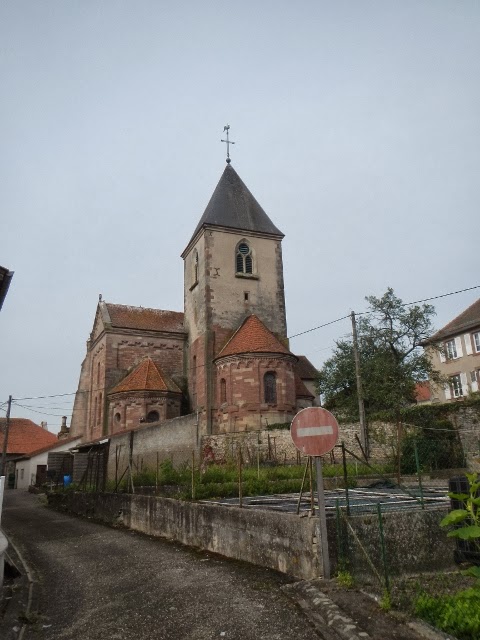
village, where we stopped to see the church, we came across a truck delivering
fresh bread to houses by hanging their orders on the door. The driver saw us watching and stopped to
sell us fresh pastries.
We did have folding bicycles, so we were able to bike into villages that were not right on the canal.
 |
| Kathy with one of the bikes |
Our first
lock was a huge one, Rechicourt-le-Chateau lock.
 |
| The lock full. Ed holding the boat in position with mooring line. |
It was built to replace 6 smaller locks and
cuts 2 hours off the transit. It lowered
the boat about 55 feet in one step.
 |
| Laurie, Sheila and Kathy in the depths of the lock. |
It was like descending into a canyon of concrete.
When it opened to let us out the lower gate lifted like a garage door.
 |
| The exit door starting to open |
We were
given a remote control that automatically worked all the locks on the canal
between this lock and Nancy. We only had
problems twice. Once the lower gates
didn’t open to let us out, and once they didn’t close to fill.
 |
| A typical lock. Notice the ladder on the left where the wall indents. |
Both times we had to climb the ladder on the
wall of the lock, go to the control booth, and phone for help. Always a challenge when you can’t tell them
what is wrong in a language they understand.
We must have been understood enough because someone always came and
rescued us.
 |
| Heron on the canal |
There is a
large population of herons along the canal and it was fun to see them as we
motored past. Rabbits and a fox were the only other wild life we saw. There
were lots of farm animals in fields along the way, and fishermen sitting along
the canal fishing.
 |
Mooring on the side of the lock to walk to St. Cathedral in background.
|
 |
| Entering St. Nicholas |
The canal crossed the Meurthe river near St Nicholas, and a road near Hesse.
 |
| Canal crossing the river Meurthe |
 |
| Canal crossing the highway |
Nancy
I’d never
heard of Nancy until it became our turn around point on the trip. It is a large commercial center in Eastern
France on the confluence of major canals.
 |
| Nancy Harbor - John shoed a lot of skill getting the boat into a slip. |
It is the Paris of the east.
The city was founded in the 12th
century as the capital of the Duchy of Lorraine. The plaza in the city center
named after the last influential Duke is quite beautiful with its wrought iron
gates, baroque fountains, and hanging lanterns.
The Cathedral-Primatiale of
Nancy is also impressive. It was built between 1703 and 1742. It became a cathedral in 1777 with the
nomination of the first Bishop of Nancy
Epinal
 |
| The American Cemetery at Epinal |
John has an
uncle, PFC George D. Kinkade Jr., who died in WWII during the campaign to break
the German winter line. He is buried in
the American cemetery in Epinal 50 miles
south of Nancy. As soon as we moored in
the Nancy harbor, John and I headed to Epinal to visit his grave. We assumed we could catch a train, or a bus,
or rent a car. I had looked on line months ahead and trains did go from Paris
to Epinal via Nancy. However, our arrival time didn’t work for mass transit and
they looked at us in wonder when we asked about renting a car. So we took a taxi for the same amount we
figured a rental car would cost. It was
interesting negotiating the trip the driver spoke no English, no Laurie to
rescue us, and my French is poor. He understood he was to take us, stay, and
bring us back, and we knew the amount he would charge. We told him we would need to stop at an ATM
and he understood that very well.
 |
| Looking from George's grave back to the center memorial seeing 1/4 of the graves. |
The American
Cemetery is very impressive covering 49+ acres.
There are 5,255 graves and the names of 424 missing in action engraved
on a memorial wall. They have the memorial and beautifully laid out grounds, as
well as a visitor’s center for family members to sit by a fire reminisce or
grieve. The staff in charge treated us
like royalty because we had family buried there. They were getting ready to celebrate their
day of freedom from the Germans with all the big wigs of the area and military personnel
attending, and they stopped to take care of us.
We were escorted to John’s uncle’s grave. Sand from Normandy was rubbed into his head
stone so that the inscription would stand out.
They then took a picture of us
at the grave which was put in a frame and presented to us as we left. It was a very moving experience to say the
least.
Hesse
This was our
starting and ending point. It is a
quaint town with a restaurant, bakery, and the ruins of a Benedictine Abbey.
 |
| Abbey from the south |
 |
| John at the original gate to the abbey grounds |
Arzviller Lock
Our taxi cab drive who took us from the airport in Strasburg to Hesse and then returned to take us back to Strasburg, stopped at the lock that had broken and changed our travel plans. We toured the lock. It lifts the boats in a cradle pulled up the incline by steel cables. I'm not sure I'd have enjoyed the experience of being pulled up the hillside in a canal section.
 |
| The incline the boats travel up |
 |
| The cradle that the boats are in when lifted |
 |
| A model of the incline plane lift |